
Trading from zero: a complete beginner’s guide to crypto trading
Learn crypto trading from nothing: how exchanges and order books work, spot vs futures, order types, leverage, liquidation, fees, long and short, and risk.
Most people start trading backwards. They see a chart going up, open an account, press buy, and only later find out what a liquidation is, usually by having one. This lesson puts things in the order they should have been in. By the end you will know what you are actually doing when you press a button on an exchange, and how much it can cost you.
It is long, because it has to be. Everything in the rest of the Academy, from support and resistance to liquidity zones, assumes you understand the pieces here. Read it in one sitting if you can, with a cup of something, and do the small calculations yourself rather than skimming them.
What a market actually is
A market is a place where people who want to buy meet people who want to sell. That’s all. The price of Bitcoin on your screen is not set by anyone; it is just the price at which the most recent buyer and seller agreed to trade.
In crypto, those meetings happen on exchanges. Each exchange runs a separate market for each pair of assets, written like BTCUSDT. The first part is what you are trading (Bitcoin), the second is what you are paying with (USDT, a stablecoin meant to stay near one US dollar). So when BTCUSDT shows 60,000, it means one Bitcoin is currently trading for about 60,000 USDT on that exchange.
Prices on different exchanges are almost the same, because traders and bots quickly buy where it is cheaper and sell where it is dearer. That’s also why you can read a chart from one exchange and trade on another without much difference on the big pairs.
Why the price moves at all
Price moves when one side is more eager than the other. If more people want to buy right now than want to sell at the current price, buyers have to offer more to get filled, and the price rises. If sellers are in a hurry, they accept less, and it falls. News, fear, greed, liquidations and big players all feed into that eagerness, but the mechanism is always the same: orders meeting orders.
The order book: where trades happen
Every market on an exchange has an order book. It is a live list of everyone waiting to trade, split in two halves.
- Bids are buy orders waiting below the current price. Each one says “I’ll buy this much at this price”.
- Asks are sell orders waiting above the current price. Each one says “I’ll sell this much at this price”.
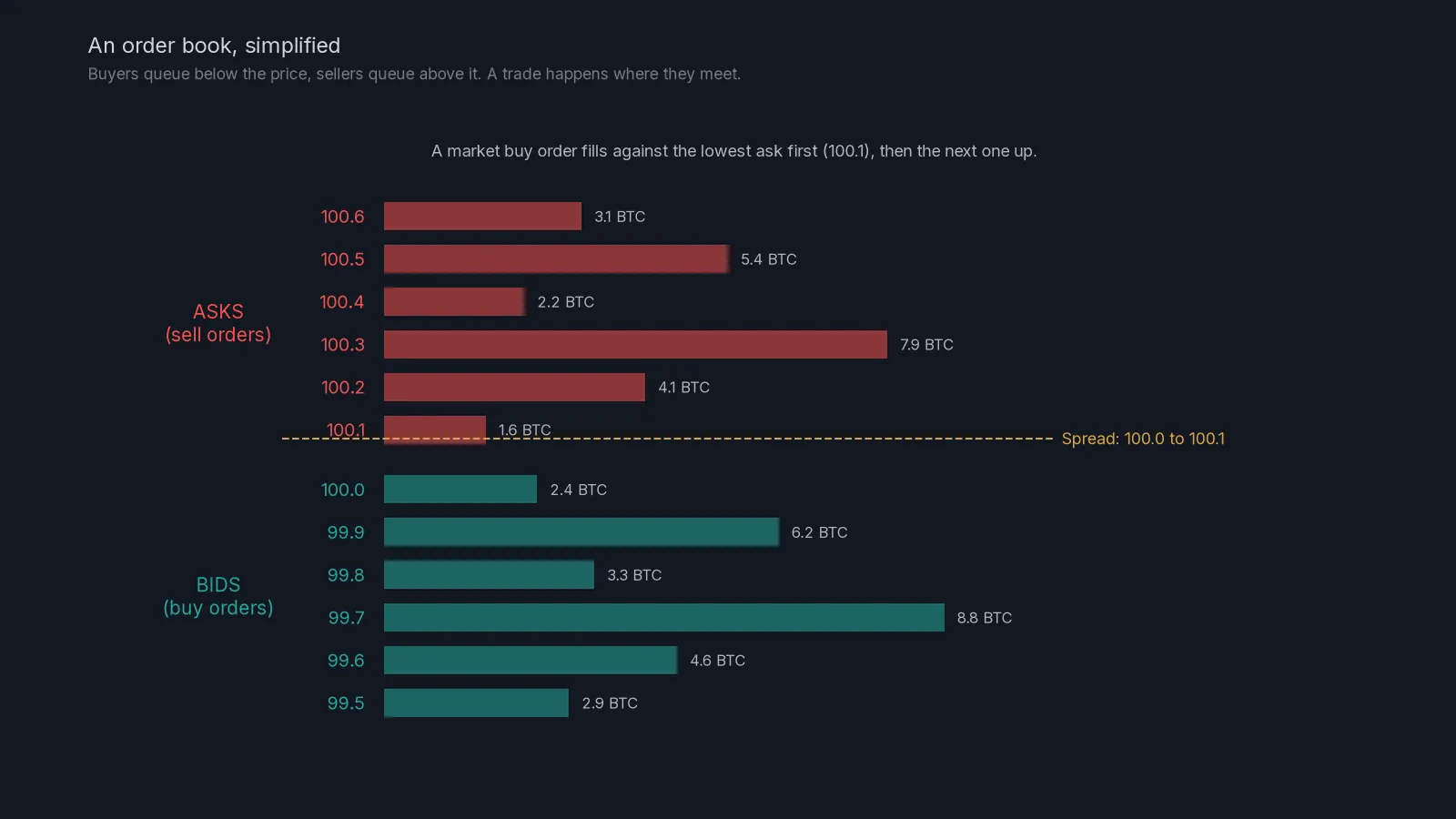
The best bid and the best ask are the two prices closest to each other. The small gap between them is called the spread. On BTCUSDT it is usually a cent or so. On a small coin it can be much wider, which is a hidden cost: you buy at the ask and could only sell immediately at the bid.
When you place an order that trades right away, you take orders out of the book. When you place an order that waits, you add one to the book. That difference matters for two reasons we’ll come to: the price you get, and the fee you pay.
Order types you need to know
Exchanges offer a dozen order types. You need four of them to start.
Market order
A market order says “fill me now at whatever the best price is”. It always fills, as long as anyone is on the other side. The catch is that you don’t control the price. If you buy 2 BTC with a market order and there is only 1.6 BTC at the best ask, the rest fills at the next price up. That difference between what you expected and what you got is called slippage. On big pairs with small orders it’s tiny. In a fast market or on a thin coin it can be painful.
Limit order
A limit order says “buy at this price or lower” (or “sell at this price or higher”). It waits in the book until price comes to it. You control the price, but you might not get filled at all if price never gets there. Limit orders are what most planned entries use, including the entries in our liquidity signals.
Stop-market order (a stop-loss)
A stop order sits invisible until price touches a trigger, then it becomes a market order. Used to exit, it is your stop-loss: “if price reaches X, get me out”. Because it becomes a market order, it can fill a little worse than the trigger in a fast move. A stop limits your risk; it doesn’t make it zero.
Take-profit order
The mirror of a stop-loss: an order that closes your position at a chosen price in profit. Some traders set one at entry, others manage the exit by hand. Our signals deliberately leave the exit to you, and crypto AI signals explained covers why.
A useful habit. Before every trade, write three prices down: entry, stop and the rough area where you would take profit. If you can’t name the stop, you are not ready to place the entry.
Spot vs futures
This is the single biggest decision a beginner makes, often without realising it is a decision.
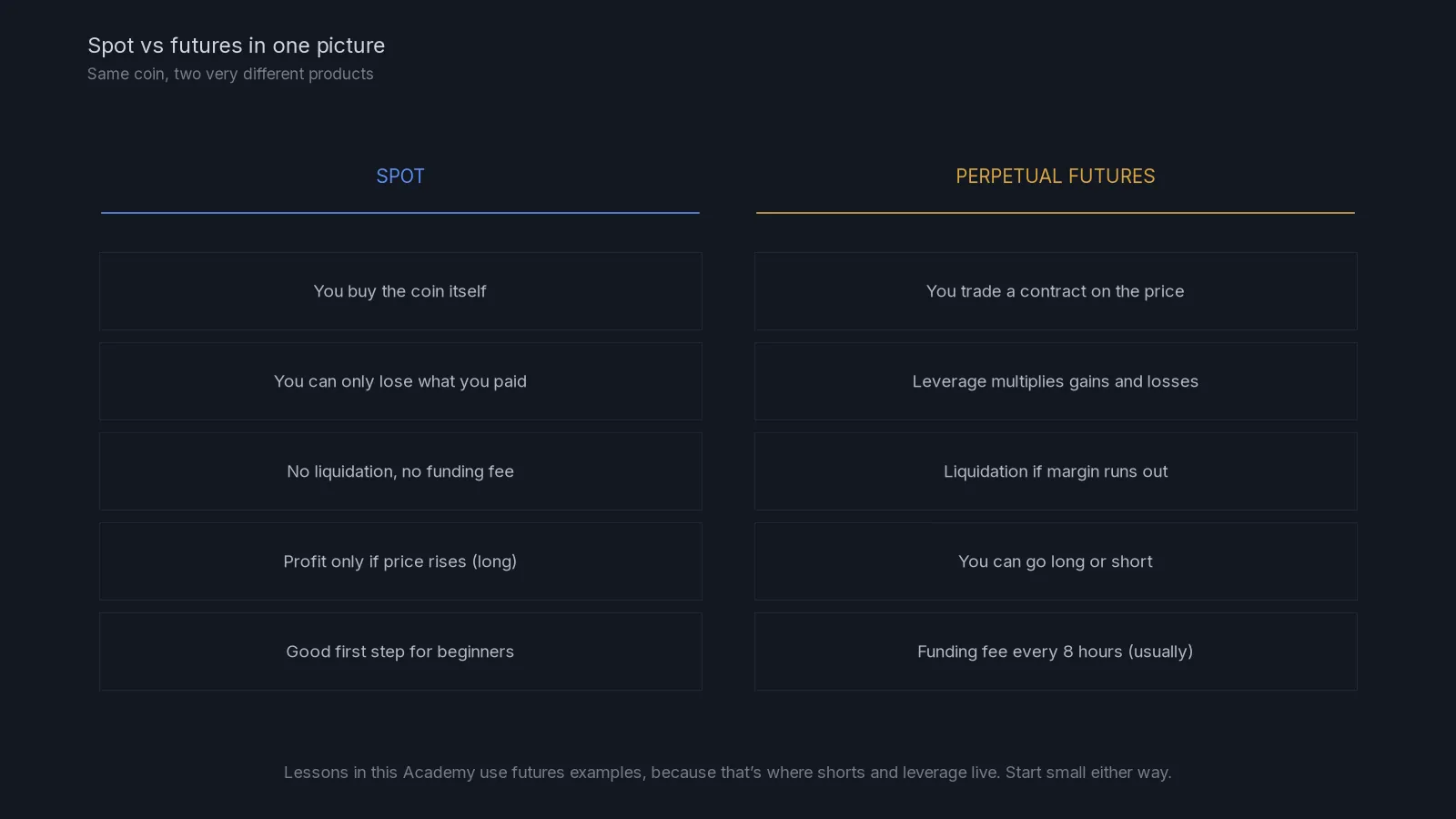
On spot, you buy the coin itself. If you buy 0.01 BTC for 600 USDT, you own 0.01 BTC. If the price halves, your coins are worth 300 USDT, but you still own them and nobody can close your position. You can only lose what you put in, and you only profit if the price goes up.
On futures, you don’t own any coin. You hold a contract whose value follows the price. Crypto exchanges mostly offer perpetual futures, which never expire. Two features make futures different:
- You can go short, which means profit when price falls.
- You can use leverage, which means you control a position bigger than the money you put up.
To keep the perpetual contract close to the real spot price, exchanges use a funding rate: a small payment between longs and shorts, usually every eight hours. When most traders are long and the contract trades above spot, longs pay shorts. It’s typically a fraction of a percent, but it adds up if you hold for days.
Our signals are written for futures because liquidity shorts need the ability to short. That doesn’t mean you must start on futures. Many traders spend their first months on spot, learning to read charts with no liquidation risk, and only then move across.
Long and short, with numbers
Going long means you buy first and sell later, hoping to sell higher. Going short means you sell first and buy back later, hoping to buy back lower. On futures both are a single click; the exchange handles the borrowing behind the scenes.
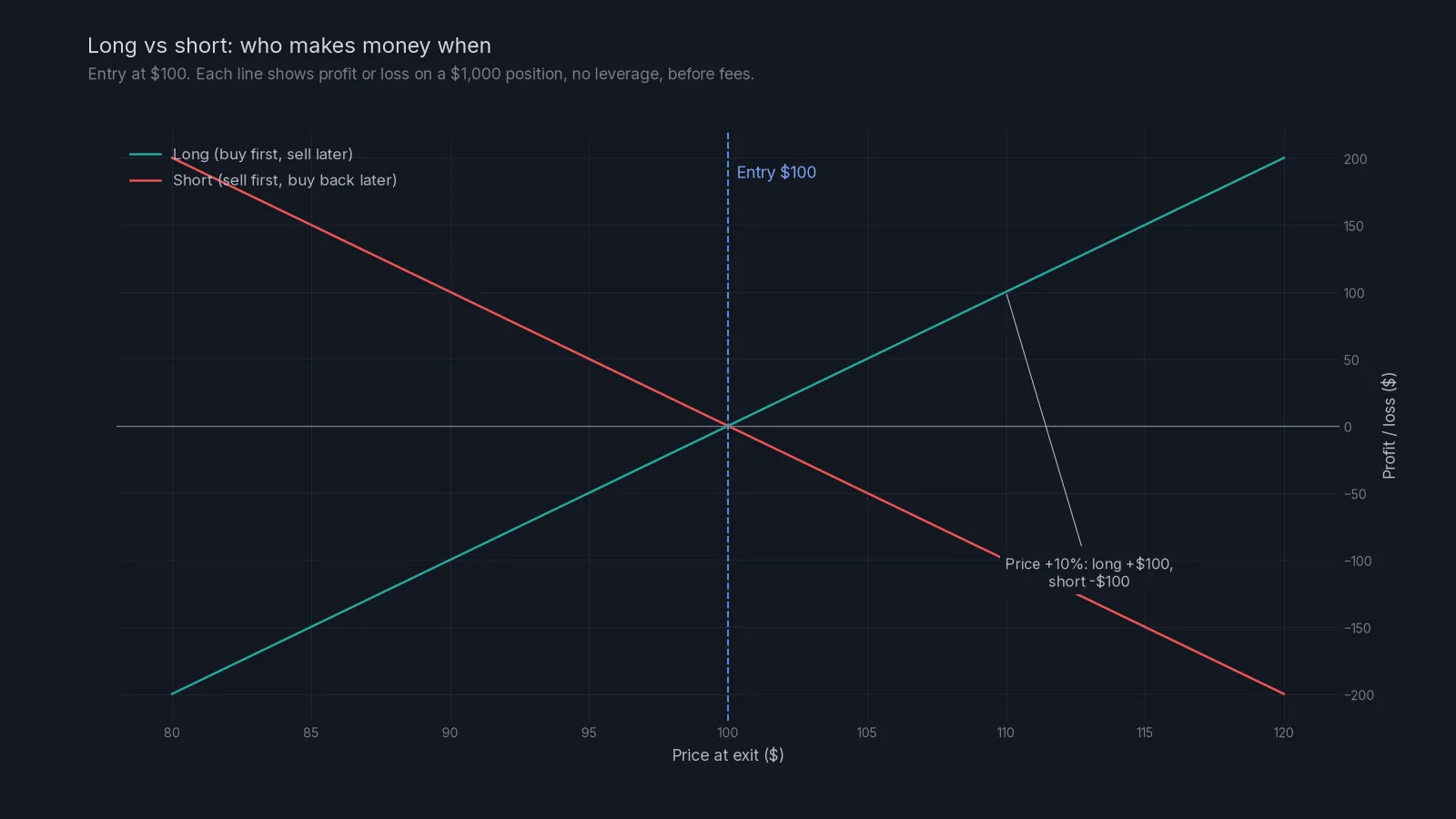
Here is a worked example with a $1,000 position and no leverage.
| Price move | Long result | Short result |
|---|---|---|
| $100 to $110 (+10%) | +$100 | -$100 |
| $100 to $95 (-5%) | -$50 | +$50 |
| $100 to $102 (+2%) | +$20 | -$20 |
Notice the third row. A 2% move against a short costs $20 on a $1,000 position. That is exactly the size of move our reference stop allows for, and it’s why the stop and the position size have to be thought about together. We do that properly in the position sizing lesson.
Leverage and liquidation
Leverage is where most beginners get hurt, so let’s go slowly.
On futures you put up margin, which is your own money held against the position. Leverage tells you how big the position is compared with that margin. With $100 of margin:
- at 1x you control a $100 position
- at 5x you control $500
- at 10x you control $1,000
- at 20x you control $2,000
The price moves the same amount whatever leverage you choose. What changes is how much of your margin each move consumes. On a $1,000 position, a 1% move is $10. At 10x your margin is $100, so that 1% move is 10% of your margin. A 10% move against you is the whole $100.
When the loss gets close to your margin, the exchange closes the position for you. That forced exit is a liquidation, and it is not a stop you chose. It happens at the exchange’s price, often with an extra fee, and you lose the margin on that position.
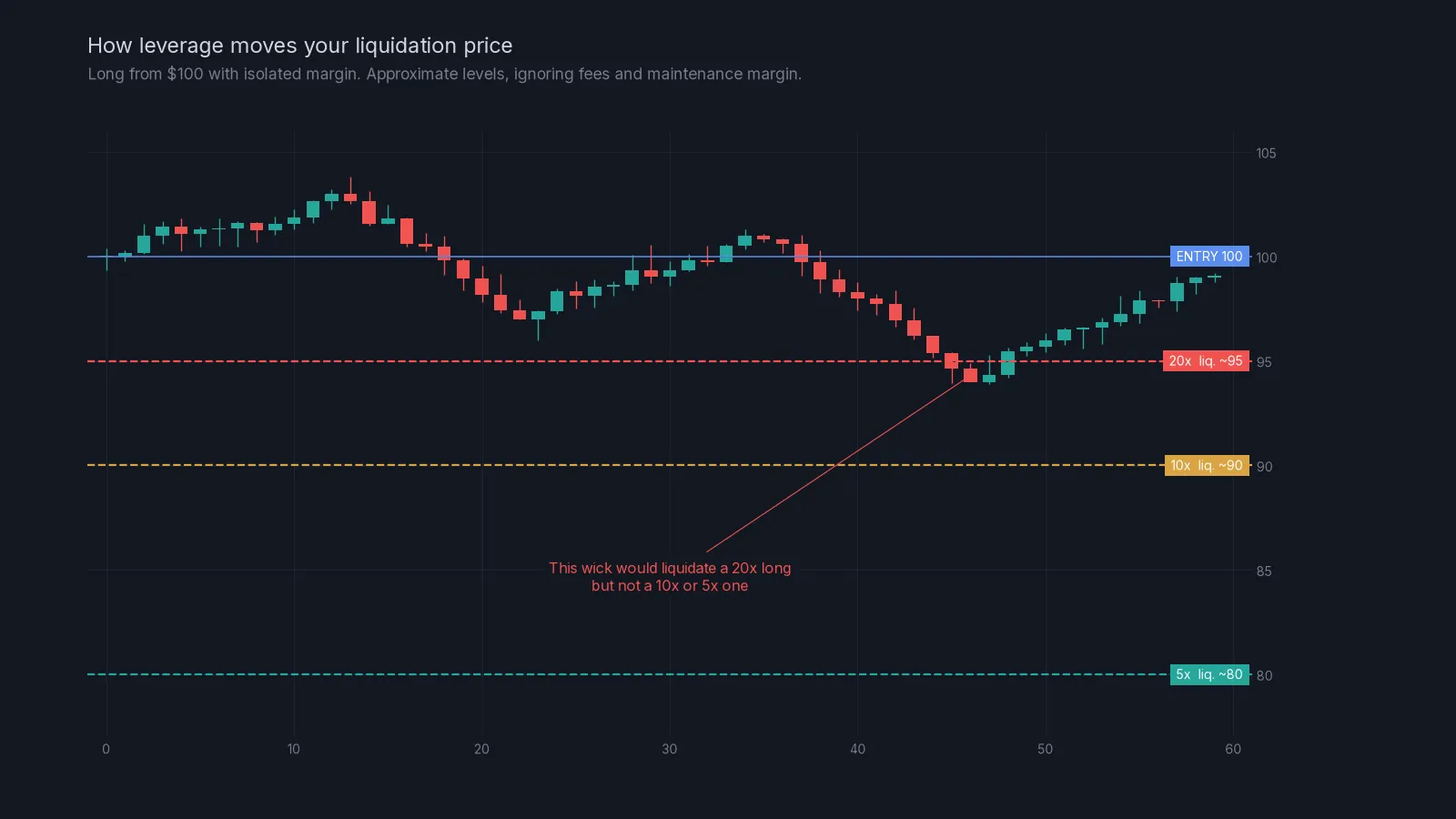
A rough rule for a long with isolated margin: the liquidation price sits about (100 ÷ leverage) percent below your entry, a little less once you account for the exchange’s maintenance margin and fees. For a short it sits that far above.
| Leverage | Approx. distance to liquidation | Long from $100 liquidates near |
|---|---|---|
| 2x | 50% | $50 |
| 5x | 20% | $80 |
| 10x | 10% | $90 |
| 20x | 5% | $95 |
| 50x | 2% | $98 |
Now combine this with a stop. If your plan has a 2% stop and you use 50x leverage, your liquidation sits about where your stop is, and in practice slightly before it. Your stop will never get the chance to work. The rule that follows is simple and worth memorising: your liquidation price must always be well beyond your stop. Our position size calculator checks this for you.
Isolated vs cross margin
In isolated mode, each position has its own margin. If it gets liquidated, you lose that margin and nothing else. In cross mode, the whole futures balance backs every position, so a losing trade can keep drawing on your other funds until the account is nearly empty. Beginners should use isolated margin. It makes the worst case of each trade visible in advance.
Fees: the cost nobody counts
Exchanges charge a fee on every fill. There are two kinds:
- Maker fee when your order waits in the book and someone else fills it (a limit order). Often about 0.02%.
- Taker fee when your order takes from the book (a market order or a triggered stop). Often about 0.05%.
The important detail is that fees are charged on the position value, not on your margin. Here is what that looks like for one round trip, entering with a limit and exiting with a market order, on a $1,000 position:
| Entry fee (0.02%) | Exit fee (0.05%) | Total | |
|---|---|---|---|
| $1,000 position | $0.20 | $0.50 | $0.70 |
| $10,000 position (same $1,000 margin at 10x) | $2.00 | $5.00 | $7.00 |
Seven dollars sounds small until you remember the trade above risks maybe $20 or $40. Add funding and slippage, and costs can quietly eat a large share of each small win. Check your exchange’s actual fee table; the figures above are typical, not universal.
Risk: the part that keeps you trading
Every lesson after this one is about finding good trades. This section is about surviving the bad ones, and there will be plenty. Even good traders lose often. What separates them is that each loss is small and planned.
The standard approach is to risk a fixed, small share of your account on each trade. Many traders use 0.5% to 2%. Here’s how it works with a $2,000 account and 1% risk:
- Decide the loss you accept: 1% of $2,000 is $20.
- Find the stop distance: you plan a short at $100 with a stop at $102, a distance of $2 per coin, or 2%.
- Divide: $20 ÷ $2 = 10 coins. Your position is 10 coins, worth $1,000.
- Choose leverage only now: at 5x the margin is $200, at 10x it is $100. Either way, if the stop is hit you lose about $20 plus fees.
- Check liquidation: at 10x a short liquidates roughly 10% above entry, near $110, well beyond the $102 stop. Fine.
Read step 4 again, because it’s the most misunderstood idea in trading. Leverage did not change the risk. The stop and the position size did. Leverage only decided how much margin you parked on the exchange. Traders who pick leverage first (“I’ll do 20x”) and position size second are doing it backwards, and that is where accounts disappear.
Before your first real trade, check each of these:
- I know whether I am on spot or futures, and why.
- My futures account is set to isolated margin.
- I have written down entry, stop and a rough exit area.
- My risk on this trade is a fixed share of my account, and I know the amount in dollars.
- My position size came from that amount divided by the stop distance.
- My liquidation price is well beyond my stop.
- I have counted the fees on the full position value.
- If the stop is hit, I will accept it and not move it further away.
Common beginner mistakes
Starting with high leverage. The most common way to lose a first deposit. A 5% wick, which is an ordinary day in crypto, liquidates a 20x position.
Moving the stop. The stop was the price at which the idea was wrong. Moving it after entry turns a planned small loss into an unplanned large one.
Trading too many coins. Small coins have wider spreads, thinner books and bigger wicks. Learn on BTC and ETH first.
Ignoring fees and funding. Many small trades at high leverage can lose money even with more winners than losers.
Revenge trading. After a loss, the urge is to win it back immediately with a bigger trade. That’s the moment to stop for the day.
Copying signals without understanding them. A signal is a plan someone else prepared. If you can’t say why the entry and stop are where they are, you can’t manage the trade when it moves. The rest of this Academy is designed to fix exactly that.
Where to go next
You now know the machinery. The next step is learning to read the chart that sits on top of it. Lesson 02 walks you through TradingView, the charting tool most traders use, and lesson 03 covers the basics of technical analysis. If you want to see how all of this comes together in a real trade plan, our pricing section explains the 7-day trial of our signals, but there is no rush. The lessons are free and they will still be here.
Check yourself
Answer in your head first, then open the answer.
You have $500 of margin and open a position at 10x leverage. How big is the position?
Show answer
$5,000. Leverage multiplies your margin to give the position size: $500 × 10.
Your account is $3,000 and you risk 1% per trade. Your stop is 2% from entry. What position size should you use?
Show answer
1% of $3,000 is $30. A 2% stop means each $1 of position loses $0.02 if the stop is hit, so $30 ÷ 0.02 = a $1,500 position. The leverage you choose only changes the margin.
Why is a 50x position with a 2% stop a bad idea?
Show answer
At 50x the liquidation price is about 2% from entry, roughly where the stop is. The exchange will liquidate you before your stop can fill.
Which order type is more likely to suffer slippage: a market order or a limit order?
Show answer
A market order. It fills at whatever prices are available right now, while a limit order only fills at your price or better.
On a $4,000 position, what is the taker fee at 0.05%?
Show answer
$2. Fees are charged on the full position value, not on the margin.
Frequently asked questions
Do I need a lot of money to start trading crypto?
No. You can learn with a very small amount, and you should. The point of the first months is to learn the process, not to make money. Risking 1% of a small account teaches the same habits as risking 1% of a large one.
Is futures trading gambling?
It can be, if you trade without a plan or with high leverage. With a defined stop, a position size based on a fixed risk and low leverage, it is a way to express a view on price with a known worst case. The tool is the same; the behaviour decides which one it is.
Should I start with spot or futures?
Spot is the gentler start, because you can’t be liquidated. If you want to follow our liquidity short signals, you’ll need futures eventually, but there is nothing wrong with practising chart reading on spot or with tiny futures positions first.
What is a good leverage for a beginner?
Low enough that your liquidation price sits far beyond your stop. For a 2% stop, that usually means 5x or less in practice. Remember that leverage doesn’t decide your risk; your position size and stop do.
Why do exchanges show two different prices, last price and mark price?
The last price is the most recent trade. The mark price is a fair value the exchange calculates from several sources, and it’s what liquidations are based on. It stops one odd trade on a quiet book from liquidating everyone.
Crypto AI Signals sends liquidity shorts, RSI and AI plans to a private Telegram channel, each with an entry and a stop; you place and manage the trade yourself. Try it for 7 days or read the FAQ.
Risk notice. This lesson is education, not financial advice. Crypto futures are leveraged and you can lose some or all of the capital you trade with. A stop-loss limits a loss to the level you set; slippage and fast markets can make it larger. Past examples do not predict future results. Every trade you place is your own decision.